
SNAP Noncitizen Eligibility
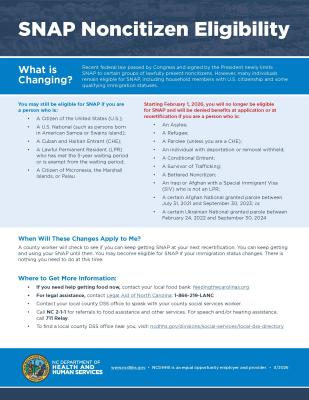
Recent federal law passed by Congress and signed by the President newly limits SNAP to certain groups of lawfully present noncitizens. However, many individuals remain eligible for SNAP, including household members with U.S. citizenship and some qualifying immigration statuses.
Your county Department of Social Services (DSS) will review your eligibility at your next recertification. You can keep getting and using your SNAP benefits until then. There is nothing you need to do at this time.
Communications Toolkit (English)
| Preview Image | Download Link |
|---|---|
| SNAP Noncitizen Eligibility Flyer |
| Preview image | Download Link |
|---|---|
| SNAP Noncitizen Eligibility FAQs |
| Preview Image | Download Link and Caption |
|---|---|
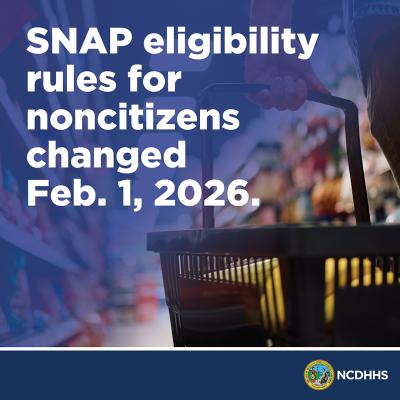
| Caption: SNAP eligibility rules for noncitizens changed Feb. 1, 2026. If you or someone in your household is a noncitizen receiving SNAP, your eligibility will be reviewed at your next recertification. Many people will remain eligible. Visit ncdhhs.gov/fns to learn more about the changes. #SNAPNC #FoodAssistance |
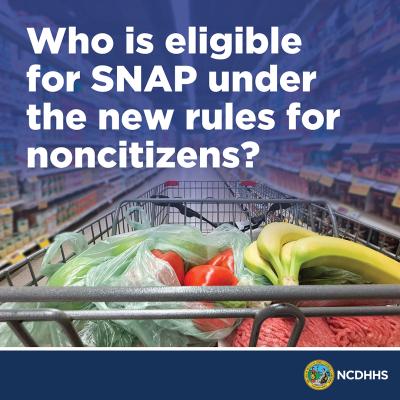
| Caption: Who is eligible for SNAP under the new rules for noncitizens? Lawful Permanent Residents (green card holders), Cuban and Haitian Entrants, and Citizens of Micronesia, Marshall Islands, or Palau. Your county DSS will review your eligibility at your next recertification. Learn more at ncdhhs.gov/fns. #SNAPNC |
| Caption: When will SNAP noncitizen eligibility changes affect me? Changes are reviewed at your next scheduled recertification. Your current benefits will continue until then, if you are otherwise eligible. Visit ncdhhs.gov/fns for details. #SNAPNC |
| Caption: When will SNAP noncitizen eligibility changes affect me? If your household has members with different immigration statuses: Eligible household members will continue to receive their SNAP benefits. Only people applying for SNAP need to provide immigration documents. ncdhhs.gov/fns #SNAPNC |
| Caption: Have questions about SNAP noncitizen eligibility changes? Visit ncdhhs.gov/fns for details. Find your county DSS: ncdhhs.gov/dss-directory. #SNAPNC |
| Caption: Have questions about your immigration status and SNAP eligibility? Free legal services are available in North Carolina. Contact Legal Aid of NC at 1-866-219-5262 or visit legalaidnc.org. ncdhhs.gov/fns #SNAPNC |
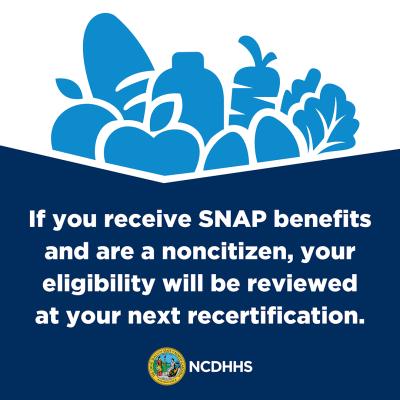
| Caption: H.R. 1 changed SNAP noncitizen eligibility requirements effective February 1, 2026 in NC. If you receive SNAP benefits and are a noncitizen, your eligibility will be reviewed at your next recertification. Your county DSS will explain how these changes may affect you. Visit ncdhhs.gov/fns to learn more. #SNAPNC |
| Preview Image | Download Link and Caption |
|---|---|
|
| Caption: SNAP eligibility rules for noncitizens changed Feb. 1, 2026. If you or someone in your household is a noncitizen receiving SNAP, your eligibility will be reviewed at your next recertification. Many people will remain eligible. Visit ncdhhs.gov/fns to learn more about the changes. #SNAPNC #FoodAssistance |
|
| Caption: Who is eligible for SNAP under the new rules for noncitizens? Lawful Permanent Residents (green card holders), Cuban and Haitian Entrants, and Citizens of Micronesia, Marshall Islands, or Palau. Your county DSS will review your eligibility at your next recertification. Learn more at ncdhhs.gov/fns. #SNAPNC |
|
| Caption: When will SNAP noncitizen eligibility changes affect me? Changes are reviewed at your next scheduled recertification. Your current benefits will continue until then, if you are otherwise eligible. Visit ncdhhs.gov/fns for details. #SNAPNC |
|
| Caption: When will SNAP noncitizen eligibility changes affect me? If your household has members with different immigration statuses: Eligible household members will continue to receive their SNAP benefits. Only people applying for SNAP need to provide immigration documents. ncdhhs.gov/fns #SNAPNC |
|
| Caption: Have questions about SNAP noncitizen eligibility changes? Visit ncdhhs.gov/fns for details. Find your county DSS: ncdhhs.gov/dss-directory. #SNAPNC |
|
| Caption: Have questions about your immigration status and SNAP eligibility? Free legal services are available in North Carolina. Contact Legal Aid of NC at 1-866-219-5262 or visit legalaidnc.org. ncdhhs.gov/fns #SNAPNC |
|
| Caption: H.R. 1 changed SNAP noncitizen eligibility requirements effective February 1, 2026 in NC. If you receive SNAP benefits and are a noncitizen, your eligibility will be reviewed at your next recertification. Your county DSS will explain how these changes may affect you. Visit ncdhhs.gov/fns to learn more. #SNAPNC |
Kit de herramientas de comunicación (Español)
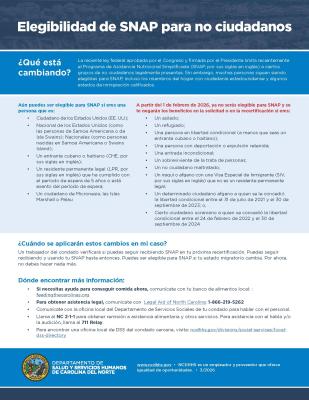
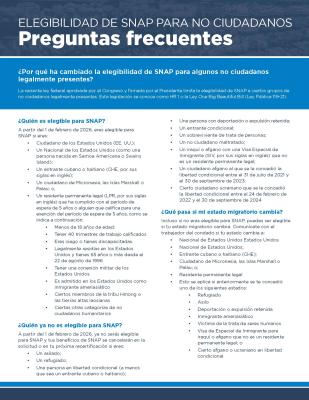
| Vista previa | Descargar |
|---|---|
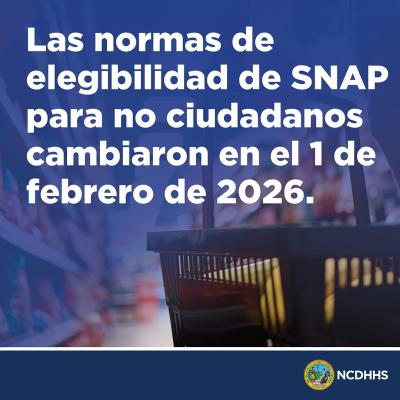
| Leyenda: Las normas de elegibilidad de SNAP para no ciudadanos cambiaron el 1 de febrero de 2026. Si tú o alguien en tu hogar no es ciudadano que recibe SNAP, su elegibilidad será revisada en su próxima recertificación. Muchas personas seguirán siendo elegibles. Visita ncdhhs.gov/fns para obtener más información sobre los cambios. #SNAPNC #FoodAssistance |
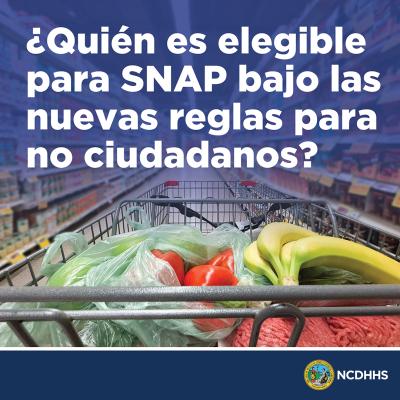
| Leyenda: ¿Quién es elegible para SNAP bajo las nuevas normas para no ciudadanos? Residentes permanentes legales (titulares de la tarjeta verde), entrantes cubanos y haitianos, y ciudadanos de Micronesia, Islas Marshall o Palau. El Departamento de Servicios Sociales de tu condado revisará tu elegibilidad en tu próxima recertificación. Obtén más información en ncdhhs.gov/fns. #SNAPNC |
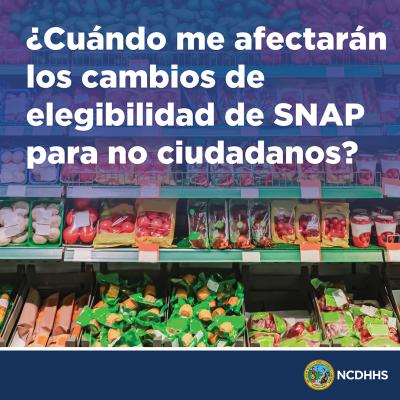
| Leyenda: ¿Cuándo me afectarán los cambios de elegibilidad de SNAP para no ciudadanos? Los cambios se revisan en tu próxima recertificación programada. Tus beneficios actuales continuarán hasta entonces, si eres elegible. Visita ncdhhs.gov/fns para obtener más información. #SNAPNC |
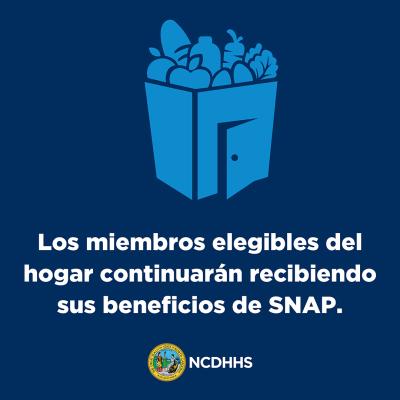
| Leyenda: ¿Cuándo me afectarán los cambios de elegibilidad de SNAP para no ciudadanos? Si tu hogar tiene miembros con diferentes estados migratorios: los miembros elegibles del hogar continuarán recibiendo sus beneficios de SNAP. Solamente las personas que solicitan SNAP deben proporcionar documentos de inmigración. ncdhhs.gov/fns #SNAPNC |
| Leyenda: ¿Tienes preguntas sobre los cambios en los requisitos de SNAP para no ciudadanos? Visita ncdhhs.gov/fns para obtener más información. Encuentra el Departamento de Servicios Sociales de tu condado: ncdhhs.gov/dss-directory. #SNAPNC |
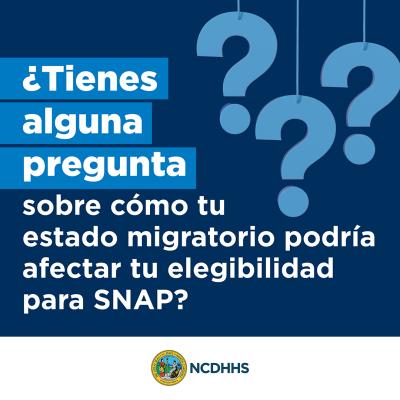
| Leyenda: ¿Tienes preguntas sobre tu estado migratorio y la elegibilidad para SNAP? Los servicios legales gratuitos están disponibles en Carolina del Norte. Comunícate con Legal Aid of NC al 1-866-219-5262 o visita legalaidnc.org. ncdhhs.gov/fns #SNAPNC |
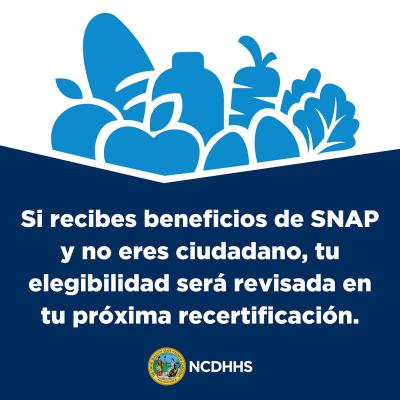
| Leyenda: HR 1 cambió los requisitos de elegibilidad de SNAP para no ciudadanos a partir del 1 de febrero de 2026 en Carolina del Norte. Si recibes beneficios de SNAP y no eres ciudadano, tu elegibilidad será revisada en tu próxima recertificación. El Departamento de Servicios Sociales de tu condado te explicará cómo estos cambios pueden afectarte. Visita ncdhhs.gov/fns para obtener más información. #SNAPNC |
| Vista previa | Descargar |
|---|---|
|
| Leyenda: Las normas de elegibilidad de SNAP para no ciudadanos cambiaron el 1 de febrero de 2026. Si tú o alguien en tu hogar no es ciudadano que recibe SNAP, su elegibilidad será revisada en su próxima recertificación. Muchas personas seguirán siendo elegibles. Visita ncdhhs.gov/fns para obtener más información sobre los cambios. #SNAPNC #FoodAssistance |
|
| Leyenda: ¿Quién es elegible para SNAP bajo las nuevas normas para no ciudadanos? Residentes permanentes legales (titulares de la tarjeta verde), entrantes cubanos y haitianos, y ciudadanos de Micronesia, Islas Marshall o Palau. El Departamento de Servicios Sociales de tu condado revisará tu elegibilidad en tu próxima recertificación. Obtén más información en ncdhhs.gov/fns. #SNAPNC |
|
| Leyenda: ¿Cuándo me afectarán los cambios de elegibilidad de SNAP para no ciudadanos? Los cambios se revisan en tu próxima recertificación programada. Tus beneficios actuales continuarán hasta entonces, si eres elegible. Visita ncdhhs.gov/fns para obtener más información. #SNAPNC |
|
| Leyenda: ¿Cuándo me afectarán los cambios de elegibilidad de SNAP para no ciudadanos? Si tu hogar tiene miembros con diferentes estados migratorios: los miembros elegibles del hogar continuarán recibiendo sus beneficios de SNAP. Solamente las personas que solicitan SNAP deben proporcionar documentos de inmigración. ncdhhs.gov/fns #SNAPNC |
|
| Leyenda: ¿Tienes preguntas sobre los cambios en los requisitos de SNAP para no ciudadanos? Visita ncdhhs.gov/fns para obtener más información. Encuentra el Departamento de Servicios Sociales de tu condado: ncdhhs.gov/dss-directory. #SNAPNC |
|
| Leyenda: ¿Tienes preguntas sobre tu estado migratorio y la elegibilidad para SNAP? Los servicios legales gratuitos están disponibles en Carolina del Norte. Comunícate con Legal Aid of NC al 1-866-219-5262 o visita legalaidnc.org. ncdhhs.gov/fns #SNAPNC |
|
| Leyenda: HR 1 cambió los requisitos de elegibilidad de SNAP para no ciudadanos a partir del 1 de febrero de 2026 en Carolina del Norte. Si recibes beneficios de SNAP y no eres ciudadano, tu elegibilidad será revisada en tu próxima recertificación. El Departamento de Servicios Sociales de tu condado te explicará cómo estos cambios pueden afectarte. Visita ncdhhs.gov/fns para obtener más información. #SNAPNC |
Detailed Information
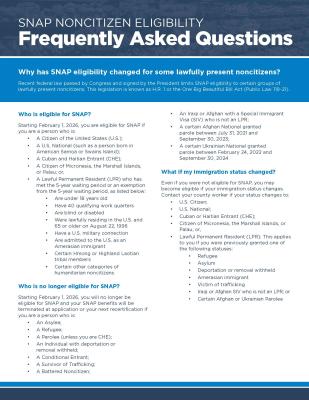
Recent federal law passed by Congress and signed by the President newly limits SNAP to certain groups of lawfully present noncitizens. This legislation is known as H.R. 1 or the One Big Beautiful Bill Act (Public Law 119-21).
Starting February 1, 2026, you are eligible for SNAP if you are a person who is:
- A Citizen of the United States (U.S.);
- A U.S. National (such as a person born in American Samoa or Swains Island);
- A Cuban and Haitian Entrant (CHE);
- A Citizen of Micronesia, the Marshall Islands, or Palau; or,
- A Lawful Permanent Resident (LPR) who has met the 5-year waiting period or an exemption from the 5-year waiting period, as listed below:
- LPRs may qualify without the 5-year waiting period if they:
- Are under 18 years old
- Have 40 qualifying work quarters
- Are blind or disabled
- Were lawfully residing in the U.S. and 65 or older on August 22, 1996
- Have a U.S. military connection
- Were previously admitted as an Amerasian immigrant and have adjusted to LPR status
- Certain Hmong or Highland Laotian tribal members
- Certain American Indians born abroad (under INA 289 or the Indian Self-Determination Act)
- Certain other categories of humanitarian noncitizens
- LPRs may qualify without the 5-year waiting period if they:
If you are a noncitizen and applied for SNAP recently, you will be eligible for SNAP only if you are a U.S. Citizen, U.S. National, LPR, CHE, or Citizen of Micronesia, the Marshall Islands, or Palau, and you meet all other financial eligibility criteria. A county worker will determine if you are eligible for benefits when you apply or when you recertify. If there are multiple people in your household with different immigration statuses, you will receive a notice showing who is approved and who is denied.
Starting February 1, 2026, you will no longer be eligible for SNAP and your SNAP benefits will be terminated at application or your next recertification if you are a person who is:
- An Asylee;
- A Refugee;
- A Parolee (unless you are a Cuban/Haitian Entrant);
- An Individual with deportation or removal withheld;
- A Conditional Entrant;
- A Survivor of Trafficking;
- A Battered Noncitizen;
- An Iraqi or Afghan with a Special Immigrant Visa (SIV) who is not an LPR;
- A certain Afghan National granted parole between July 31, 2021 and September 30, 2023; or,
- A certain Ukrainian National granted parole between February 24, 2022 and September 30, 2024
Important: You will not have to repay any SNAP benefits you received before this change in law took effect.
A county worker will check to see if you can keep getting SNAP at your next recertification. You can keep getting and using your SNAP until then. You may become eligible for SNAP if your immigration status changes. There is nothing you need to do at this time.
You can find your recertification date by logging onto your ePASS account at epass.nc.gov or by contacting your county DSS office. Your most recent notice of eligibility also includes your certification period end date.
A county worker will review your eligibility at your next recertification. You will receive a notice if you are no longer eligible to receive SNAP. For example, if your next annual recertification is due in September 2026, that is when your immigration status will be reviewed to determine if you are still eligible.
Most people recertify every 6 months, but some households have a longer certification period. These households include:
- Those with only an elderly member (65+) who are receiving Supplemental Security Income who have a 36-month certification period.
- Those with only elderly (60+) and/or disabled members and no earned income who have a 12-month certification period.
Even if you were not eligible for SNAP, you may become eligible if your immigration status changes. Contact your county worker if your status changes to:
- U.S. Citizen;
- U.S. National;
- Cuban or Haitian Entrant (CHE);
- Citizen of Micronesia, the Marshall Islands, or Palau; or,
- Lawful Permanent Resident (LPR): This applies to you if you were previously granted one of the following statuses:
- Refugee
- Asylee
- Deportation or removal withheld
- Amerasian immigrant
- Victim of trafficking
- Iraqi or Afghan SIV who is not an LPR; or
- Certain Afghan or Ukrainian Parolee
Previously held a humanitarian status?
If you were previously a refugee, asylee, trafficking victim, or held another humanitarian status and have since adjusted to LPR, you may be exempt from the 5-year waiting period under FNS 227.06(B). Former refugees, asylees, persons with deportation withheld, Amerasian immigrants, survivors of trafficking, Iraqi/Afghan SIVs, and certain Afghan and Ukrainian parolees who adjust to LPR status retain their exemption from the 5-year waiting period. Contact your county DSS to review your situation.
SNAP eligibility is determined for each individual in your household. Some members may still be eligible even if others are not.
If you are currently receiving SNAP, a county worker will review your eligibility at your next recertification and send you a notice showing which people in your household are still eligible.
If you applied for SNAP, a county worker will review your application, make a determination, and send you a notice showing who is approved and who is denied.
Your household's benefit amount may be adjusted to reflect the change in household composition.
Key point: Only the ineligible individual's benefits will be affected. Other household members who are citizens or otherwise eligible will continue to receive their benefits.
Contact your local food bank for food assistance: feedingthecarolinas.org
Call NC 2-1-1 for referrals to food assistance and other services
Contact North Carolina Women, Infants, and Children (WIC) services if you are pregnant, postpartum, breastfeeding, have an infant, or a child up to age 5.
Free or low-cost legal help is available across North Carolina. These organizations can help you understand your immigration status and how it relates to SNAP eligibility:
- Legal Aid of North Carolina — Free legal services for low-income individuals statewide.1-866-219-5262
- NC Justice Center — Immigration and benefits policy assistance. 919-856-2570
- Charlotte Center for Legal Advocacy — Immigration legal services in the Charlotte area. 704-376-1600
- Catholic Charities Diocese of Charlotte — Immigration legal services. 704-370-3262
- Catholic Charities Diocese of Raleigh — Immigration legal services. 984-900-3114
- World Relief Durham — Immigration legal services in the Triangle area. 919-286-4411
- World Relief Triad — Immigration legal services in the Triad area. 336-887-9007
- Pisgah Legal Services — Immigration legal services in western NC. 828-253-0406
Learn more about the Public Charge Rule.
NCDHHS FNS Policy
- FNS-CN-01-2026: Change Notice - Change notice implementing HR1 Section 10108 noncitizen eligibility revisions
- FNS 227: Noncitizen Eligibility (Policy Manual Section) - NC FNS Policy Manual Section 227, covering noncitizen eligibility requirements
Resources and Contacts
Check Your Benefits
- Find Your Local County DSS Office - Contact your county worker with questions about your eligibility
- ePASS - Check your recertification date or apply for benefits online
Get Food Assistance
North Carolina's regional food banks and their partner networks of food pantries, meal providers, and nonprofit organizations are available to support individuals and families who may lose SNAP eligibility due to these federal changes.
Even with robust support, food banks can provide only a fraction of the nutritional assistance that federal programs like SNAP provide. For every meal that a food bank provides, SNAP provides nine.
| Food Bank | Area Served |
|---|---|
| Food Bank of the Albemarle | Northeast NC |
| Second Harvest Food Bank of Southeast NC | Fayetteville and Southeast NC |
| Food Bank of Central & Eastern North Carolina | Greater Triangle Region through Coastal NC |
| Inter-Faith Food Shuttle | Greater Triangle Region |
| Second Harvest Food Bank of Metrolina | Greater Charlotte area |
| Second Harvest Food Bank of Northwest NC | Greater Triad area and Northwest NC |
| MANNA Food Bank | Western NC |
- NC 2-1-1 - Dial 2-1-1 or visit nc211.org to connect with local food pantries, meal programs, and other essential services. Available 24/7 and in multiple languages.
- NC211 Emergency Food Access and Basic Needs Map - Search by zip code for food resources across all of NC
- Feeding the Carolinas - Statewide network connecting all NC regional food banks
- NC WIC Program - For pregnant, postpartum, breastfeeding individuals, infants, and children up to age 5
Get Legal Help
If you have questions about how these federal changes may affect your immigration status or SNAP eligibility, free and low-cost legal services are available in North Carolina.
| Organization | Area Served | How to Get Help |
|---|---|---|
| Legal Aid of North Carolina | Statewide (All 100 Counties) | 1-866-219-LANC (5262) legalaidnc.org |
| NC Justice Center | Statewide | Immigration intake: 1-888-251-2776 Civil intake: 919-856-2162 ncjustice.org |
| Charlotte Center for Legal Advocacy | Charlotte-area | 704-376-1600 (Mecklenburg) 800-438-1254 (outside Mecklenburg) Spanish line: 800-247-1931 charlottelegaladvocacy.org |
| Pisgah Legal Services | Western NC | 828-253-0406 toll-free: 800-489-6144 pisgahlegal.org |
For speech and/or hearing assistance, call 711 Relay.